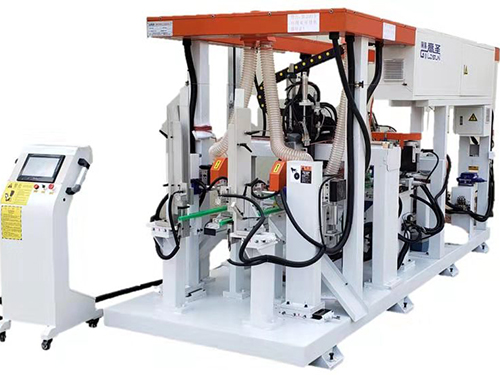
I. Four prominent characteristics of woodworking machinery processing:
Woodworking machinery is quite familiar to many people. However, there are four particularly prominent characteristics when it comes to the processing of woodworking machinery:
1. When woodworking machinery is used for cutting or processing, the cutting speed of the tool is generally quite high, and the vibration is also significant, along with a considerable amount of noise. 2. The manufacturing precision of woodworking machinery is generally low.
3. The rotational speed of the tool shaft of woodworking machinery is relatively high, and the inertia is also considerable. Therefore, the difficulty of braking is quite obvious.
4. During the processing of woodworking machinery, another operation that requires manual work is relatively large, and the labor intensity is also very high.
II. Safety operation of woodworking machinery requires caution:
The use of machinery and tools has brought many conveniences to our lives and saved a lot of effort. Of course, when using woodworking machinery, we must pay attention to and be cautious about certain matters. Otherwise, it is easy for good things to turn into bad things.
Before operating woodworking machinery, it is necessary to perform a test run step to ensure that all components are working normally. Also, a general inspection of the operating environment should be conducted to ensure that it is a safe environment before starting the operation. Operators should wear professional work clothes. If not, it is prohibited to enter the working area wearing loose clothes or with unkempt hair to prevent accidental entanglement of clothing and hair in the woodworking machinery and cause an accident.
If unexpected and abnormal situations occur during operation, the power supply should be cut off immediately. It is particularly important to note that the switch must be used in a single direction and cannot be opened in reverse. For the debris generated by the woodworking machinery during operation, it is strictly forbidden to pick it up directly with hands. Instead, the power should be turned off and the machine should be stopped before cleaning.
III. Three common dangers of woodworking machinery and protective measures for transmission mechanisms:
The commonly used transmission mechanisms of woodworking machinery include: gear transmission mechanism, belt transmission mechanism, screw and nut transmission mechanism, and coupling, etc. These mechanisms are all rotating bodies with high-speed motion, which can cause varying degrees of harm to our personal safety. Therefore, reliable protective devices must be installed on the dangerous parts of the transmission mechanisms to ensure personal safety.
Here are specific instructions on how to implement protective measures:
1. Protection of coupling devices:
The flange disc, key, pin, and connecting bolts protruding outside the shaft and other factors are all dangerous factors, which can cause injuries to people by entangling clothing. Therefore, measures such as countersunk screws, safety couplings without protruding parts, and cylindrical protective covers should be adopted to ensure safe transmission.
2. Protection of gear meshing transmission: In the transmission of the gear system, any of the straight teeth, inclined teeth, conical teeth, and worm gears are very dangerous. Therefore, most gear transmissions use fully enclosed protective devices, such as the main shaft gearbox and feed gearbox of various machines. However, there are always a few gears exposed outside the machine, which can also cause injuries. Therefore, protective devices should be installed on all exposed gears outside the machine. The protective covers are mostly made of iron plates welded together, and their shapes should match the shape of the transmission device. The installation should be firm and stable, with a smooth and beautiful appearance, without sharp corners, and should be convenient for opening, maintenance, and repair.
3. Belt transmission:
Belt transmission is smooth, has low noise, and has a simple structure, and can prevent overload. Therefore, it is widely used in machine transmission. However, due to the high-speed rotation of the belt, it is prone to friction and electricity generation and discharge phenomena, so it is not suitable for use in places prone to fire and explosion. The main danger of belt transmission lies in the area where the belt enters the pulley and the joint of the flat belt. Therefore, for the belt transmission mechanisms used on machines, belt protective covers should be installed. For wide and high-speed belts more than 2 meters above the ground, protective measures should also be taken. Generally, the belt guards for woodworking machinery are made of thin iron plates and should be firmly fixed to prevent them from falling off due to vibration. When using the belt, pay attention to ensuring that the joint is securely fastened and the tightness is appropriate to prevent it from breaking.
10 Major Safety Precautions for Operating a Planer Machine in Woodworking Machinery:
1. The machine can only use a one-way switch, not a reverse-forward dual switch.
2. The cutting depth should generally not exceed 1.5 millimeters. The feeding speed should be kept uniform, and when passing through the cutting edge, the force should be light. It is prohibited to feed back material above the cutting blade.
3. For wood with a thickness less than 1.5 centimeters and a length less than 30 centimeters, a press plate or push rod must be used. It is prohibited to push with hands.
4. When encountering knots or joints, the pushing speed should be reduced. It is prohibited to push with hands on the knot. For old materials, the iron nails, mud, and sand must be removed thoroughly.
5. When changing the blade, the power should be cut off or the belt should be removed. Moreover, the weight and thickness of the blades of the same planer machine must be consistent, and the blade frame and clamping plate must fit perfectly. Blades with weld seams extending beyond the blade head or with cracks are not allowed to be used. The screws fastening the blade should be embedded in the groove and no less than 10 millimeters away from the blade back. Planer machines (including three-sided and four-sided planers)
6. When cutting materials, keep your body stable and operate with both hands. When cutting the large surface, your hand should be placed on the material; when cutting the small surface, your fingers should not be lower than half the height of the material and must be no less than 3 centimeters. It is prohibited to push with your hands behind the material.
7. Woodworking planer machines must have safety protection devices; otherwise, they are not allowed to be used.
8. The length of the short material to be cut should not be shorter than the distance between the front and rear rollers; for wood with a thickness less than 1 centimeter, a support plate must be used.
9. The material should be fed straight. If the material walks sideways or gets stuck, the machine should be stopped to adjust the table surface. When encountering hard knots, slow down the feeding speed. When feeding, your fingers must be more than 20 centimeters away from the roller, and the material should be removed from the table surface before taking it.
10. The feeding and receiving material should not wear gloves and should stand on one side of the machine. The cutting depth should not exceed 5 millimeters each time.
5 Safety Instructions for Using a Circular Saw Machine in Woodworking Machinery:
Woodworking circular saw machines are the simplest and most commonly used equipment in woodworking enterprises. There are many types of woodworking circular saw machines, and their performance and functions vary. It is necessary to select different circular saw machines according to the processing requirements. For example, the longitudinal cutting and transverse cutting machines have significant differences, and the two processing methods should not use the same type of circular saw.
Nowadays, many woodworking enterprises do not have complete accessories on their woodworking circular saw machines. As a mechanical product, the factory manufactures, inspects, and produces it according to relevant standards and specifications. Although some protective components are not convenient to use, if the protective components are removed randomly without new safety measures, it will cause serious consequences.
The guide blade (splitting angle) can keep the saw cut of the workpiece at a certain tension, preventing the split saw cut from re-merging, and allowing the saw blade to function normally. If the saw blade is caught by the split workpiece, the saw blade will not be able to rotate for sawing, causing the workpiece to heat and burn. If the saw blade is severely stuck in the workpiece and jams, when the accumulated energy reaches a certain level, the workpiece will bounce out or the motor will be burned out. The guide ruler (support) mainly controls the processing size of the workpiece. The distance between the guide ruler and the saw blade is the size of the product to be sawed. The parallelism between the guide ruler and the saw blade should be adjusted properly and the width of the feed inlet and outlet of the guide ruler should be sufficient. The numerical value of the width should be related to the equipment accuracy and processing accuracy. In summary, ensure smooth and quick sawing.
Most high-quality woodworking circular saws are equipped with a reverse device, which is very effective in preventing the processed material from rebounding. When sawing short workpieces, special attention to safety protection is necessary. If the quantity is large, mechanical automatic feeding or special equipment processing should be adopted to ensure safety and high efficiency. If sawing short materials manually, it is absolutely not allowed to touch the workpiece directly with hands.
6 Safety Knowledge of Woodworking Machinery
Woodworking machinery belongs to machinery with high risks. In order to complete the processing of wood, woodworking machinery has higher cutting speeds and sharper cutting edges compared to ordinary metal cutting machines, thus making woodworking machinery more prone to causing injury accidents than ordinary metal cutting machines.
(1) Causes of woodworking machinery accidents. The main causes of woodworking machinery accidents are as follows:
1. The working spindle of woodworking machinery rotates at a high speed with a large rotational inertia, making it difficult to stop. Operators often habitually use their hands or wooden sticks to brake it, often accidentally causing their hands to come into contact with the rotating cutting tool, resulting in hand injuries.
2. Woodworking machinery mostly uses manual feeding, which is a latent cause of hand injuries. When pushing the wood material forward with the hand, due to encountering knots, bends, or other defects, the hand involuntarily contacts the cutting edge, causing cuts or even amputations.
3. The high rotational speed of woodworking machinery, combined with the uneven wood being processed, during the cutting process, there is loud noise, large vibration, high labor intensity for workers, and easy fatigue. These factors all easily cause operators to make mistakes and result in injury accidents.
4. Operators are not familiar with the performance of woodworking machinery and safety operation techniques, or do not follow safety operation procedures, and in addition, the woodworking machinery does not have safety protection devices or the safety protection devices are malfunctioning, all of which are very likely to cause injury accidents.
(2) Measures to prevent woodworking machinery accidents. The main measures to prevent woodworking machinery accidents are as follows:
1. All woodworking machinery should be equipped with effective braking devices, safety protection devices, and dust collection and chip removal devices.
2. During the use of woodworking machinery, it must be ensured that at any cutting speed and with any cutting tool, there will be no harmful vibrations. The bearings on the spindle and heart shaft rotate at high speed, and their axial clearance should be large enough to avoid danger when operating.
3. All exposed belt pulleys, rotating discs, and rotating shafts should have protective cover shells.
4. The spindle and electrical components should have interlocking devices to prevent accidental contact with the power button when installing, removing, or replacing the cutting tool, causing injury.
5. Where conditions permit, automatic feeding devices should be installed for all woodworking machinery.